I stopped counting somewhere past 2,000.
Two thousand individual people, sat in front of my camera for a headshot. Some of them wanted to be there. Most of them didn’t. A few genuinely dreaded it.
One person cried.
That kind of volume teaches you things that no photography course ever will. Not just about lighting or posing, but about people. How they see themselves, how they react under pressure, and how to get something genuine out of someone who’d rather be anywhere else.
Simpler Lighting, Better Results
When I started shooting headshots professionally, I was overcomplicating things. Three or four lights, hair lights, rim lights, fill lights. The kind of setup that looks impressive but creates problems the moment you’re photographing more than a handful of people.
The issue is consistency.
Every person who sits down in front of you has a different face shape, different skin tone, different body type. A complex lighting setup that looks beautiful on one person can create harsh shadows on the next.
And when you’re shooting 80 people in a day, you don’t have time to rebuild the lighting for each one.
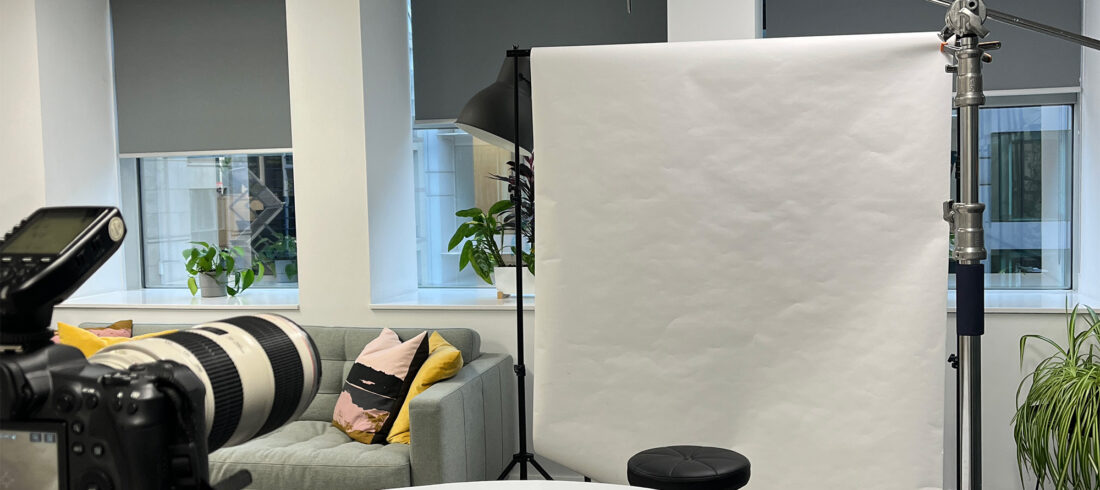
So I stripped it back. These days, I use a single overhead light with a bounce reflector underneath, essentially an adapted clamshell setup. It’s flattering across almost every face type, it’s fast to fine-tune, and it gives me consistency without sacrificing quality.
A setup that works for three people will work for 800.
That simplification was one of the biggest improvements I ever made. Not because the images look radically different, but because it freed up my attention for the thing that actually matters.
People Skills Matter More Than Camera Skills
Photography is the easy bit. Seriously. The technical side of headshots is relatively straightforward once you’ve done enough of them. The hard part is the person sitting in front of you.
Most people do not want their headshot taken.
They’ve been told by HR or their manager that it’s happening, and they’ve turned up with all the enthusiasm of someone heading to the dentist. Some people are nervous. Some are self-conscious. Some are senior leaders who’ve got a packed schedule and want it done in 90 seconds.
My job is to get something genuine out of all of them.
I’ve learned that the worst thing you can do is over-direct. Early on, I used to explain everything. “Tilt your chin slightly left, drop your right shoulder, push your forehead towards me.” People freeze up. They stop looking like themselves and start looking like someone trying very hard to follow instructions.
Now, I think of myself more as an observer making small adjustments.
I’ll get someone sitting, start chatting about their job, find something we’ve got in common, and take what I call “test shots” (they’re not test shots).
I start in their comfort zone, minimal smiling, and slowly build from there. By the time I ask for “happy eyes” or tell them to “switch their eyes back on,” they’ve already relaxed without realising it.
One of my go-to lines when someone’s clearly hating every second: “Don’t worry, the camera doesn’t know how much pain you’re in.” It almost always gets a laugh.
And a laugh, even a small one, changes the whole face.
What 800 People in 11 Days Teaches You
The biggest headshot project I’ve taken on was for a major gaming company in Edinburgh. Over 800 staff members across 11 days, done drop-in style rather than scheduled slots.
Drop-in sounds chaotic, and honestly, some days it was. I had over 200 people come through on the final day alone. But that kind of volume forces you to develop a system that works without friction.
Every person gets the same energy from me.
That’s the bit that’s mentally exhausting. I need to be switched on, friendly, cracking jokes, reading each person’s body language, adjusting my direction based on how they sit, how they hold themselves, how patient they are.
When someone makes the “can you make me look skinnier?” joke for the fiftieth time, I have to react like it’s the first time I’ve heard it.
But I genuinely love that challenge. It becomes almost like a game, especially with the people who are hard to crack. The ones who are clearly having a bad day, or who’ve been pulled away from a deadline, or who are so senior they’ve decided they’ll give you exactly two minutes and not a second more.
How do I get through to them on a human level in the time I’ve got? That’s the puzzle.
A Smooth Workflow Makes Everyone Happy
One workflow decision that consistently pleases clients: I tether my camera to a laptop running Capture One, so every image appears on screen in real time. People can see their headshot within seconds of it being taken.
This does two things. First, it reassures people. Most of the anxiety around headshots comes from not knowing what you look like. When someone can see themselves on screen and think “actually, that’s not bad,” the tension drops immediately. They relax, and the next few shots are always better.
Second, it saves the company a huge amount of time after the shoot. People make their final selection on the spot, which means no weeks of back-and-forth between HR and 50 staff members arguing over which photo to use. I can also handle file naming on site, so the images arrive ready to be uploaded straight onto the website or intranet.
Most photographers don’t bother with tethering for headshots because it’s another thing to set up and manage. But when you’re shooting for teams of 50 or 200 or 800, the time it saves everyone afterwards is worth every minute of extra setup.
You Can’t Fix How Someone Sees Themselves
After 2,000 headshots, the observation that’s stayed with me most isn’t about lighting or posing. It’s about how people see themselves.
The number of people who sit down and immediately apologise for how they look is genuinely sad. They’ll point out things I would never have noticed. And the irony is, these same people will see their colleague’s headshot and say “oh, that looks great.” It never extends to themselves.
You can’t fix that.
It’s not a photographer’s job to fix someone’s perception of themselves. All I can do is work with the person in front of me, create the best conditions for them to look like themselves on a good day, and give them simple, direct guidance that doesn’t add to their anxiety.
I had one session where a young woman got herself so worked up that she started tearing up while reviewing her images. Not because they were bad. Because she couldn’t see past her own self-criticism. That’s a tough moment to navigate, especially when there’s a queue of people waiting behind her.
In those moments, the photography is secondary. You’re just being a decent human. Take the pressure off, give them a minute, and gently remind them that nobody else sees what they see.
If You’re Planning Team Headshots
I’ve photographed teams of three and teams of 800. The approach scales, but the thing I bring to every session is the same: a setup that works for everyone, and the people skills to make sure nobody dreads the experience.
If your team needs headshots, whether that’s a handful of new starters or a full company refresh, take a look at how I work and get in touch when you’re ready.
We’ll figure out the logistics together.